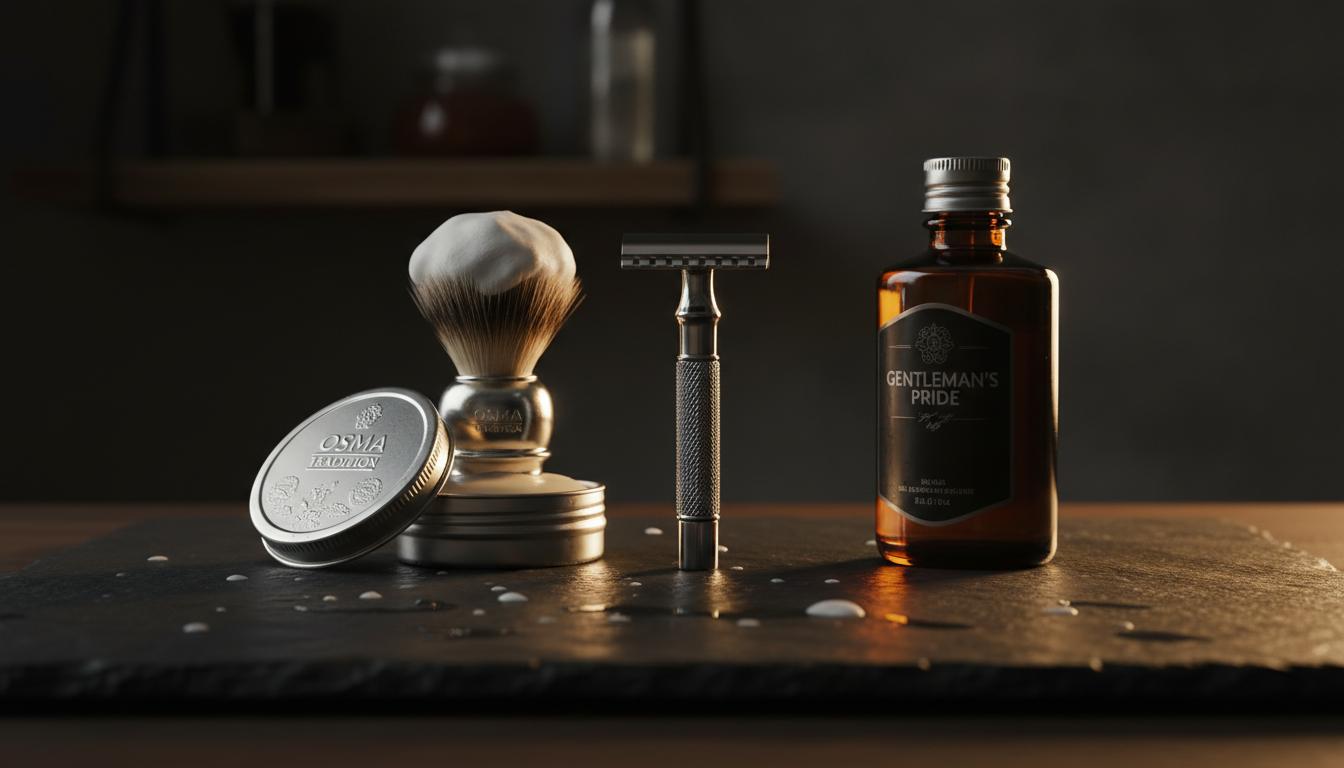
Why Switch to Wet Shaving?
Save Money
Blades cost 10-30 cents each vs $2-4 for cartridges. Save $100-200 per year.
Better Shaves
A closer, more comfortable shave with less irritation and fewer ingrown hairs.
Better for Skin
Single blade means less irritation. Your face will thank you.
Your First Shave: Step by Step
Choose Your Razor
Start with a mild-to-medium safety razor. Look for a closed-comb design with a weight of 85-95 grams. Popular beginner options include models from Merkur and Edwin Jagger. Avoid aggressive open-comb razors until you have developed your technique.
Get a Blade Sampler
Blades are personal. What works for one face may not work for another. A sampler pack with 5-7 different brands is essential. Start with smoother blades and work your way up to sharper ones as your technique improves.
Pick a Brush
A synthetic brush is the easiest starting point -- no break-in required, quick-drying, and excellent lathering. Choose a 24-26mm knot for versatility.
Choose a Soap
A soft 'croap' (cream-soap hybrid) is easier to lather than hard triple-milled soap. Look for tallow-based options with good community reviews.
Learn the Three-Pass Shave
With the grain (WTG), then across the grain (XTG), then against the grain (ATG). Use minimal pressure -- let the razor's weight do the work. Keep the blade angle at approximately 30 degrees. Rinse between passes and re-lather.
Post-Shave Care
Rinse with cold water to close pores. Apply an alcohol-free aftershave balm to soothe and moisturize. An alum block can help with any small nicks.
Your Complete Starter Kit
Beginner Mistakes to Avoid
Pressing too hard
Let the razor's weight do the work. Use almost no pressure.
Wrong blade angle
Hold the razor at roughly 30 degrees to your skin.
Going too fast
Use short, controlled strokes. Rushing causes nicks.
Skipping the prep
Shave after a hot shower or with a hot towel. Hydrated hair cuts easier.
Using a dull blade
Change blades every 3-7 shaves. When it tugs, swap it.
Frequently Asked Questions
How much does it cost to start wet shaving?▾
A complete beginner kit costs $50-$100. This includes a safety razor ($20-$40), blade sampler ($10-$15), synthetic brush ($10-$20), shaving soap ($10-$20), and aftershave balm ($8-$15). You'll break even compared to cartridges within 6-12 months.
How long is the learning curve?▾
You'll get decent shaves within the first week. Good, consistent shaves come after 2-3 weeks. Mastery takes 1-2 months of daily practice. Most men see dramatic improvement after their first 10 shaves.
Will I cut myself?▾
Minor nicks are common in the first few shaves. Serious cuts are rare because the safety guard protects most of the blade. Using proper technique -- light pressure, correct angle, short strokes -- virtually eliminates nicks after the learning period.
Is wet shaving really cheaper than cartridges?▾
Yes, significantly. Cartridge refills cost $2-$4 each and last 5-10 shaves. DE blades cost 10-30 cents each. Over a year, most wet shavers save $100-$200 compared to cartridge shaving.
Can I use regular soap or body wash?▾
No. Regular soap lacks the lubrication and cushioning properties needed for safe shaving. Shaving soap or cream is specifically formulated to create a protective, slick lather that allows the blade to glide smoothly across your skin.
Do I need a shaving bowl?▾
Not necessarily. You can build lather directly on your face (face lathering) or in your hand. A bowl can help with learning, but many experienced shavers prefer face lathering for its simplicity and the added exfoliation.