Straight Razor Head Shave: The Technique Beard Shaving Doesn’t Teach
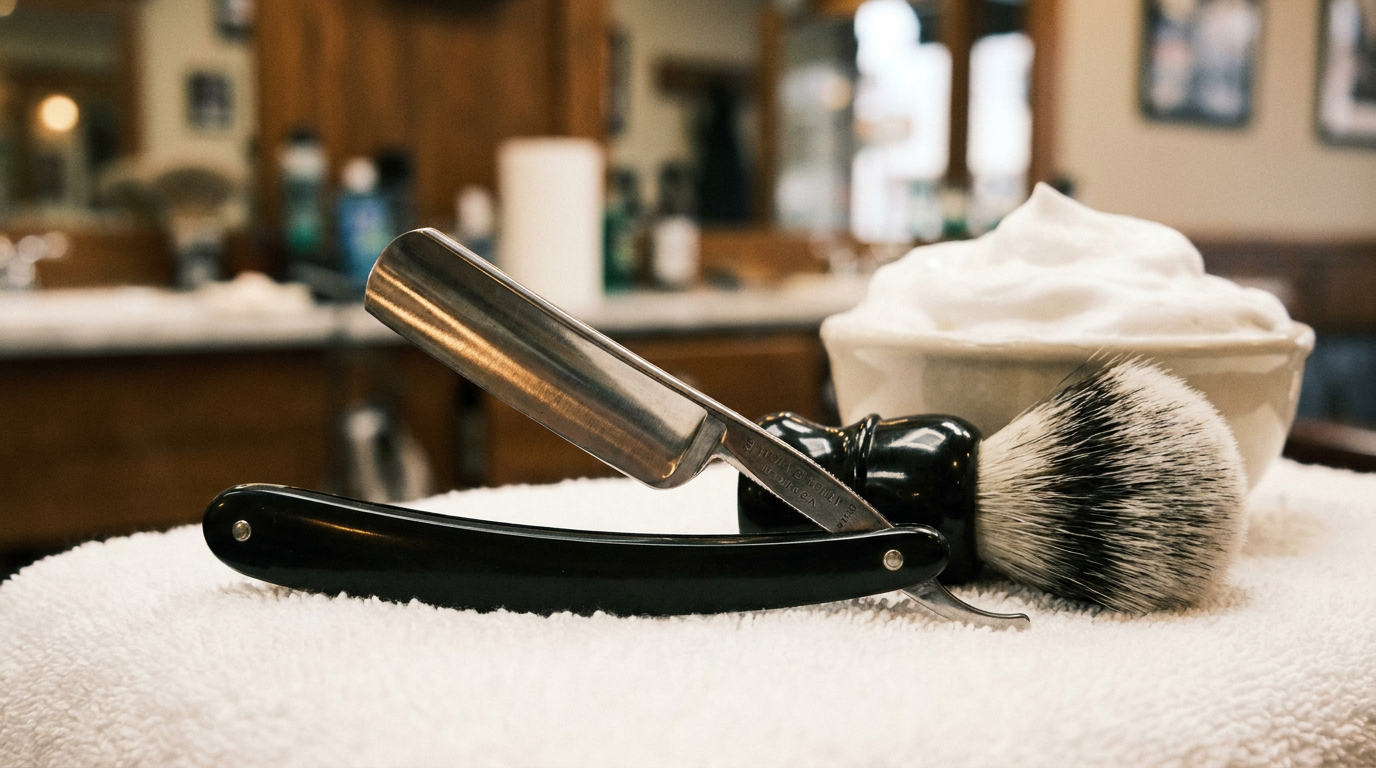
A straight razor head shave works when you stop relying on the mirror and start relying on your fingers. You map the grain by touch, shave the scalp in small sections, and use a narrow blade or a shavette that follows the curve of your skull.
Beard technique assumes a flat cheek you can watch. Your scalp is a dome you mostly cannot see.
Map the crown by feel before you lather
Scalp hair rarely grows in one direction. On most heads it spirals out from the crown, so the grain at the back of your head can point three ways within a few inches.
Run your palm over two days of growth. Smooth means with the grain, rough means against it. Your first pass always goes with the grain.
- Top of the head: grain usually runs forward from the crown.
- Sides above the ears: usually down and slightly back.
- Back of the head and neck: usually down, often swirling near the crown.
Check your own head, since these patterns vary. The neck section follows the same rules as how to shave your neck safely, so tackle it last when your hand is warmed up.
Work in sections without a mirror
Video: Nate Matthews
Split your scalp into four zones: top, left side, right side, back. Lather one zone at a time so the lather stays wet while you shave it.
Use your free hand to stretch the skin taut ahead of the blade. On a curved surface, stretching flattens the patch you are shaving, and that does the job a mirror does on your face.
Keep the spine of the blade low, roughly the same shallow angle you learned for your face. Make short strokes of an inch or two. Long sweeps over a curve lift one end of the edge and dig in the other.
Finish each zone by rubbing a palm over it to find missed patches. A handheld mirror helps you check the back, but shave by feel.
Why a narrower blade is easier on a curve
A wide blade leaves more steel in contact with your skin at once, and on a dome only part of that edge can touch. A narrower blade, or the short half-blade in a shavette, keeps more of the cutting edge on the skin as you follow the curve.
DOVO recommends 5/8 inch as the all-rounder and describes 6/8 inch for heavy beard growth, which a scalp rarely needs. If you are still building control, the straight razor learning curve applies twice over on your head.
A shavette skips honing: snap a double edge blade in half for a fresh edge every shave. If you want a traditional razor plus strop and hone, see the straight razor kit starter set.
| Option | Blade width | Manufacturer or seller description | Example model | For a scalp |
|---|---|---|---|---|
| 3/8 inch straight razor | 3/8 in (9.5 mm) | DOVO: for narrow areas such as nose, ears and eyebrows, rather unsuitable for a full shave | DOVO INOX Wedge | Detail work around the ears only |
| 5/8 inch straight razor | 5/8 in (15.9 mm) | DOVO: the most common width, recommended for beginners | DOVO Barbarossa Olive, DOVO Astrale | Best traditional choice for the whole head |
| 6/8 inch straight razor | 6/8 in (19.1 mm) | DOVO: for really thick beard growth | DOVO Bergischer Löwe Horn 6/8 | More steel than a scalp needs |
| Shavette (half DE blade) | Half double edge blade | Super Safety Razors listing: 1.7 oz, 5 3/4 in long, no honing needed | Parker SR1 | Fresh edge every shave, easiest start |
Widths and descriptions from DOVO’s straight razor types guide. Parker SR1 figures from the Super Safety Razors product listing. Metric widths converted from inches.
After the last pass
Rinse with cool water and check the whole scalp by hand one more time. Touch up missed spots with the grain only, since a third pass against the grain on a scalp is where most irritation starts.
Your scalp gets more sun than your face, so moisturise and use sunscreen when you go out bare-headed.