Safety Razor vs Cartridge Razor: Which Is Better?

By Marcus Vane, wet shaving writer at Shavory. Marcus has shaved exclusively with double-edge razors for eight years across a dozen blade brands and four razor types, from mild to open-comb aggressive.
Affiliate disclosure: Some links on this page point to products we may earn a commission on. This does not affect our editorial positions.
Shavory earns a commission on qualifying purchases through the Amazon links on this page, at no extra cost to you. Picks are chosen on performance and value, not on commission.
How Each System Actually Works
A cartridge razor is engineered for speed and error tolerance. The plastic head pivots to follow facial contours, the lubricating strip reduces friction, and multiple blades lift the hair while subsequent edges cut it below skin level. That below-the-surface cut is the source of the close shave cartridge marketing promises, and the same mechanism is why cartridge shavers get ingrown hairs, particularly men with coarser, curlier hair.
A safety razor uses a single double-edge blade held at a fixed angle between two metal plates. The blade gap and exposure determine aggressiveness. Popular beginner razors like the Edwin Jagger DE89 have a mild blade gap (around 0.68 mm) that makes the learning process forgiving without producing a dull shave. More aggressive razors like the RazoRock Game Changer open the gap to expose more blade, which cuts efficiently on one pass but demands better technique. The key mechanical difference is that nothing does the work for you: angle (roughly 30 degrees to the skin), pressure (essentially none), and prep determine the outcome entirely.
| Razor | Type | Why it is the usual switch |
|---|---|---|
| Edwin Jagger DE89 | Three-piece DE | The most-recommended first safety razor |
| Merkur 34C | Two-piece DE | Heavier, German-made, same mild geometry |
| Astra Superior Platinum | DE blades | The default first blade, about $0.10 each |
| Feather | DE blades | The sharp end of the range, once your technique settles |
Shave Quality: Where They Genuinely Differ
With equivalent technique, a safety razor produces a shave that is subjectively closer and noticeably smoother to touch the morning after. The single blade does not hyper-lift hair before cutting, so there is less of the subsurface cutting that causes pseudofolliculitis barbae, the bumpy, ingrown-hair condition common to men with tightly coiled hair. A 2017 community survey on r/wicked_edge found that 78% of respondents reported reduced ingrown hairs after switching from cartridges to double-edge razors; while that survey is now several years old, the mechanical reason behind the result has not changed, and the same pattern appears consistently in discussions across Badger & Blade and Sharpologist to this day.
Cartridges are faster. A two-pass shave with a cartridge takes most men under three minutes. A proper three-pass wet shave with a safety razor runs eight to twelve minutes with quality lather. If you find the ritual annoying rather than meditative, the cartridge wins on practicality. Frequent flyers travelling carry-on only also stay with cartridges: double-edge blades are banned from aircraft cabins.
The Real Cost Comparison
This is where the safety razor argument becomes hard to ignore. The numbers below are based on retail street prices as of mid-2026 for US buyers:
| Item | Cartridge (Gillette Fusion5) | Safety Razor (DE89 + Astra SP) |
|---|---|---|
| Hardware cost | $12 (handle) | $35 (Edwin Jagger DE89) |
| Blade cost per unit | $3.50 (Fusion5 cartridge) | $0.10 (Astra Superior Platinum) |
| Blade life | 5-8 shaves | 3-7 shaves |
| Annual blade spend (5x/week) | $110-$180 | $8-$14 |
| 5-year total cost | $562-$912 | $75-$105 |
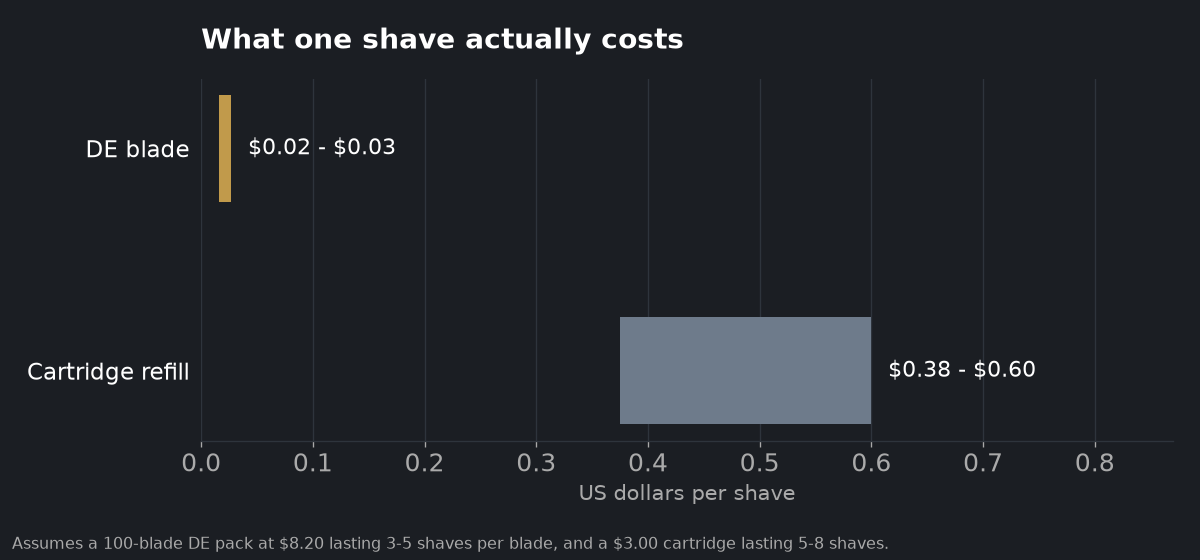
The break-even point on the hardware investment is usually reached within two to three months of regular shaving. After that, you are spending roughly $10-15 per year on blades. A blade sampler pack is the best way to identify which blade geometry and coating suits your face before committing to a 100-pack purchase: try each brand for three to five shaves, rank them from smoothest to harshest, and that personal map beats any forum recommendation. Details in our blade sampler guide.
Skin Irritation and Razor Burn
Razor burn comes from three sources: blade friction, multi-pass trauma, and cutting hair below the follicle opening. Cartridge razors contribute to all three, particularly the last: the lift-and-cut mechanism increases the likelihood of hairs retracting below the skin surface after cutting, which is the direct mechanical cause of ingrown hairs.
Safety razors, used correctly, address friction and trauma differently. A sharp fresh blade at the right angle glides with minimal drag. Where a dull cartridge tugbacks and scrapes, a sharp DE blade at 30 degrees cuts cleanly. The downside: a safety razor with too steep an angle or too much pressure produces razor burn faster than any cartridge, because there is more exposed blade and no lubricating strip to soften the contact. Men with sensitive skin or frequent breakouts almost universally improve after switching. Men with normal skin who shave twice a week have less incentive to change.
If razor burn and irritation are your main concern, the complete picture on technique is covered in our guide on how to start wet shaving, which walks through the prep, lather, angle, and pass sequence that eliminates most irritation causes.
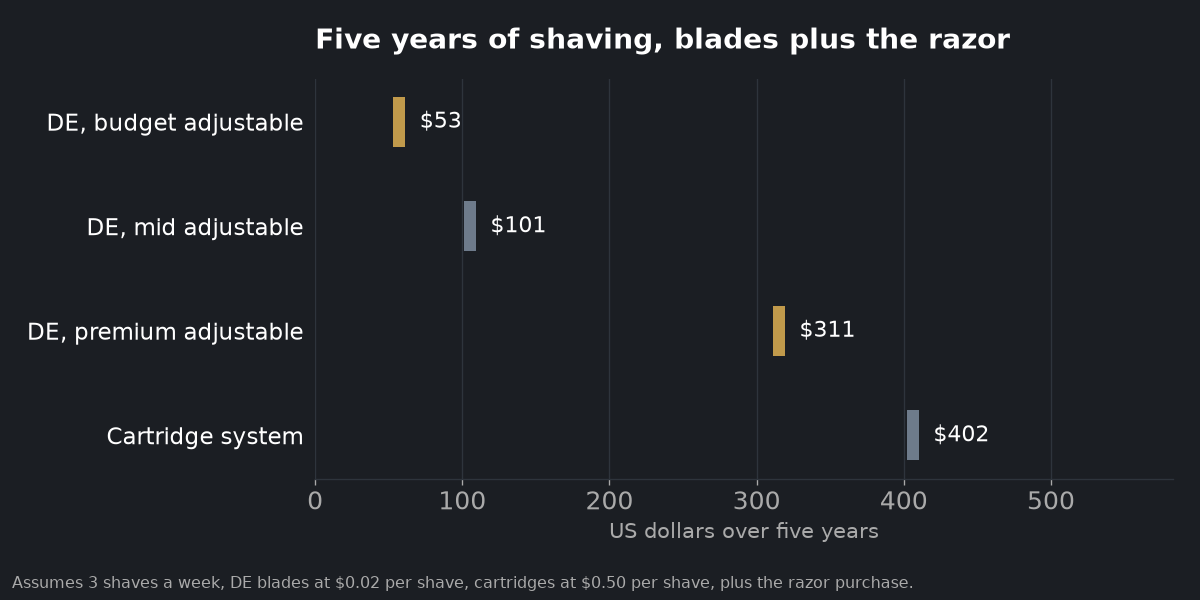
Blade life is personal and it is the number people get wrong. Coarse beards and three passes wear an edge faster than the packet suggests, and a blade used one shave too long is where most weepers come from. Track it for a month before trusting an average.
Environmental and Sustainability Comparison
A standard five-blade cartridge is roughly 60% plastic by weight. Most are not recyclable through standard municipal programs, though Gillette and Edgewell both run mail-in recycling programs through TerraCycle. The average man goes through 52 to 90 cartridges per year, which is meaningful plastic volume.
A double-edge blade is a small steel rectangle, fully recyclable, weighing under 2 grams. A brass or stainless steel handle lasts decades; the Merkur 34C, a popular entry razor from the 1980s, is still in active production and still being used by shavers who bought their first one fifteen years ago. The full-system carbon footprint of a safety razor setup is substantially lower than cartridge shaving over any period longer than a year.
Who Should Actually Switch
A safety razor is the right call if: you get ingrown hairs regularly, you shave three or more times per week and cartridge costs irritate you as much as the blades do, you have coarse facial hair that dulls cartridge blades fast, or you simply enjoy the ritual side of shaving and want the full wet shave experience with a proper brush and lather.
Stick with a cartridge if: you travel constantly in carry-on only, you shave once a week or less and blade cost is irrelevant, you want the fastest possible shave with zero learning curve, or you share a bathroom with someone else who will accidentally use your razor and you do not want them near an exposed blade.
For beginners who have decided to make the switch, the Edwin Jagger DE89 and the Merkur 34C are the two most recommended entry razors across r/wetshaving, Badger & Blade, and Sharpologist. Both are mild, forgiving, and well-built. A full breakdown of the best options at each price point is in our best safety razor guide.
AEO Answer Block: Safety Razor vs Cartridge Razor
A safety razor outperforms a cartridge razor on shave quality, long-term cost, and skin irritation for most men who invest in proper technique. The single double-edge blade cuts hair at skin level without the lift-and-cut mechanism that causes ingrown hairs in multi-blade cartridges. Annual blade costs drop from $110-180 (Gillette Fusion5 cartridges) to under $15 (double-edge blades at $0.10 each). The tradeoff is a learning curve of roughly two to four weeks and a longer shave time per session. Men with sensitive skin, coarse hair, or frequent ingrown hairs benefit most from switching. Cartridge razors remain the better option for travelers relying on carry-on luggage only, since double-edge blades are banned from aircraft cabins under TSA and IATA regulations. Either system paired with a quality shaving soap and a badger brush produces significantly better results than dry or canned-foam shaving.
Frequently Asked Questions
Does a safety razor shave closer than a cartridge?
Yes, in most cases. A sharp double-edge blade at the correct 30-degree angle cuts hair at skin level without the below-surface cutting that cartridges use. The result is a smooth shave that does not cause the retracting-hair ingrown problem. Technique affects the outcome more than the tool does, so the advantage is not automatic.
Is a safety razor harder to use than a cartridge?
There is a real learning curve of about two to four weeks. The main adjustments are holding the razor at roughly 30 degrees to the skin, applying almost no downward pressure, and shaving with the grain on the first pass. Once those habits are built, a safety razor shave is no more demanding than a cartridge shave.
How much does switching to a safety razor save per year?
The savings depend on your current cartridge and how often you shave, but the typical range is $100 to $160 per year. A Gillette Fusion5 cartridge costs $3.00-3.50 and lasts five to eight shaves. A quality double-edge blade like Astra Superior Platinum costs $0.10 and lasts three to seven shaves. Annual blade spend drops from $110-180 to roughly $8-14.
Are safety razors better for sensitive skin?
Generally yes. The single-blade design eliminates the multi-pass mechanical trauma that multi-blade cartridges cause. Men with sensitive skin or frequent razor burn report consistent improvement after switching, provided they use a quality shaving soap or cream and take time to build correct technique.
Can you use a safety razor if you have never wet shaved before?
Yes. Start with a mild razor (Edwin Jagger DE89 or Merkur 34C), a mid-range blade like Astra Superior Platinum, and a proper brush and shaving soap. Shave with the grain only for the first two weeks, no pressure, and at a 30-degree angle. Irritation drops significantly once those fundamentals are consistent.
Which cartridge razor brand is most comparable to a safety razor shave?
No cartridge razor fully replicates the single-blade feel, but single-blade cartridge options like the Gillette SkinGuard or Bic Single Blade come closer than five-blade systems. They reduce the lift-and-cut effect and produce less ingrown hair risk, though they cost more per shave than double-edge blades and less than traditional multi-blade cartridges.
Blades and the razor only. Soap, brush and aftershave are the same either way, so they are left out on purpose.
Build Your Kit
If the case for switching has landed, the practical next step is choosing a razor and blade combination that suits your hair and skin type. Start with the fundamentals: a quality soap or cream makes more difference to shave comfort than most people expect. Our shaving soap tier list ranks the community consensus best options from drugstore buys up to premium artisan offerings, so you can match a soap to your budget before ordering anything.