Best Safety Razor for Beginners
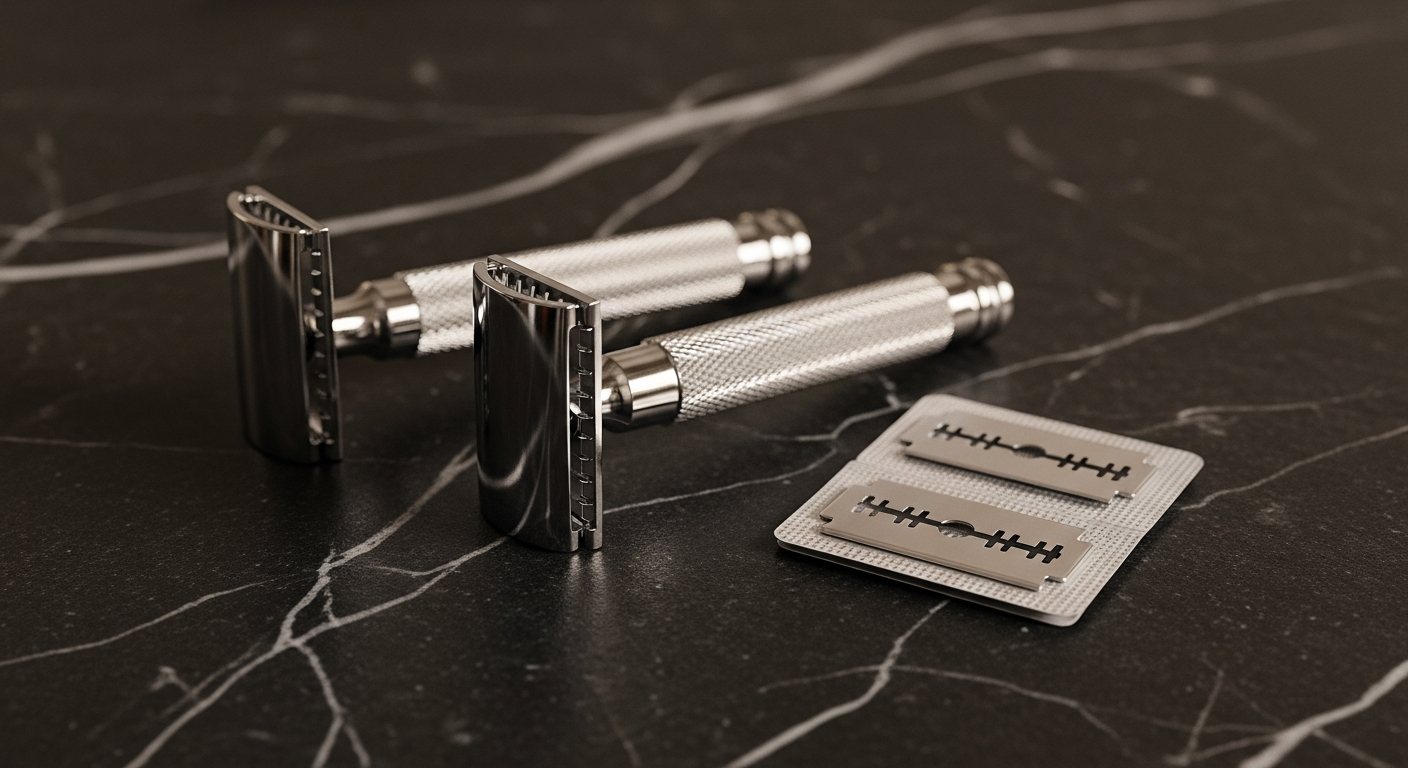
The four safety razors that come up again and again on r/wetshaving and Badger & Blade are the Edwin Jagger DE89, the Merkur 34C, the Rockwell 6S, and the Henson AL13 Mild.
Each one is mild, forgiving, and widely available. None of them require the blade-angle precision that trips up most beginners.
This guide is specifically about getting your first razor right. If you want the full lineup across all skill levels, the best safety razor roundup covers that ground. Here the focus stays on one thing: keeping your face intact while you learn.
Why Your First Safety Razor Should Be Mild
A safety razor cuts at a fixed blade angle, and that angle is everything. With a cartridge razor you can press and pivot and the blade finds the skin automatically. A safety razor does not work that way.
You hold the handle at roughly 30 degrees to your face and maintain that angle through the entire stroke. Until that motion is muscle memory, your grip and pressure will vary. A mild razor forgives those variations. An aggressive razor punishes them.
Aggressive razors like the Muhle R41 or open-comb designs expose more blade edge and amplify every micro-error. That is exactly what you do not want on week one.
The wet shaving community has a consistent position on this: start mild, learn technique, then move up if you want more efficiency. Starting aggressive because it looks like the serious option is one of the most common beginner mistakes documented in r/wetshaving threads.
Shavory earns a commission on qualifying purchases through the Amazon links on this page, at no extra cost to you. Picks are chosen on performance and value, not on commission.
The Top Beginner Safety Razors
Edwin Jagger DE89
The Edwin Jagger DE89 is probably the single most-recommended beginner razor across every wet shaving forum. The head geometry is mild with a shallow blade exposure that makes the correct angle easy to find and hold.
The handle has enough knurling to give you grip without being uncomfortable, and the weight sits around 68g, which is substantial without being heavy. It is manufactured in Sheffield, England, takes any standard double edge blade, and costs around $35-$45 depending on the handle variant.
The chrome finish is durable, and the two-piece design is simple to load. For most people it remains their go-to razor long after they graduate from beginner status.
Check price on Amazonchrome, closed comb
Merkur 34C
The Merkur 34C is the other name you will see in virtually every “best first razor” thread on Badger & Blade. The short, chunky handle (HD stands for Heavy Duty) gives excellent control for anyone who finds longer handles unwieldy.
The closed comb head is forgiving enough that pressure mistakes rarely result in blood. Merkur makes the 34C in Germany, and the tolerances on the head are tight enough that blade loading is consistent every time.
Street price runs around $35-$45. The weight at 79g is slightly heavier than the DE89, which many beginners find helps them let the razor do the work rather than pressing into the skin.
Check price on Amazonshort handle, heavy
Rockwell 6S
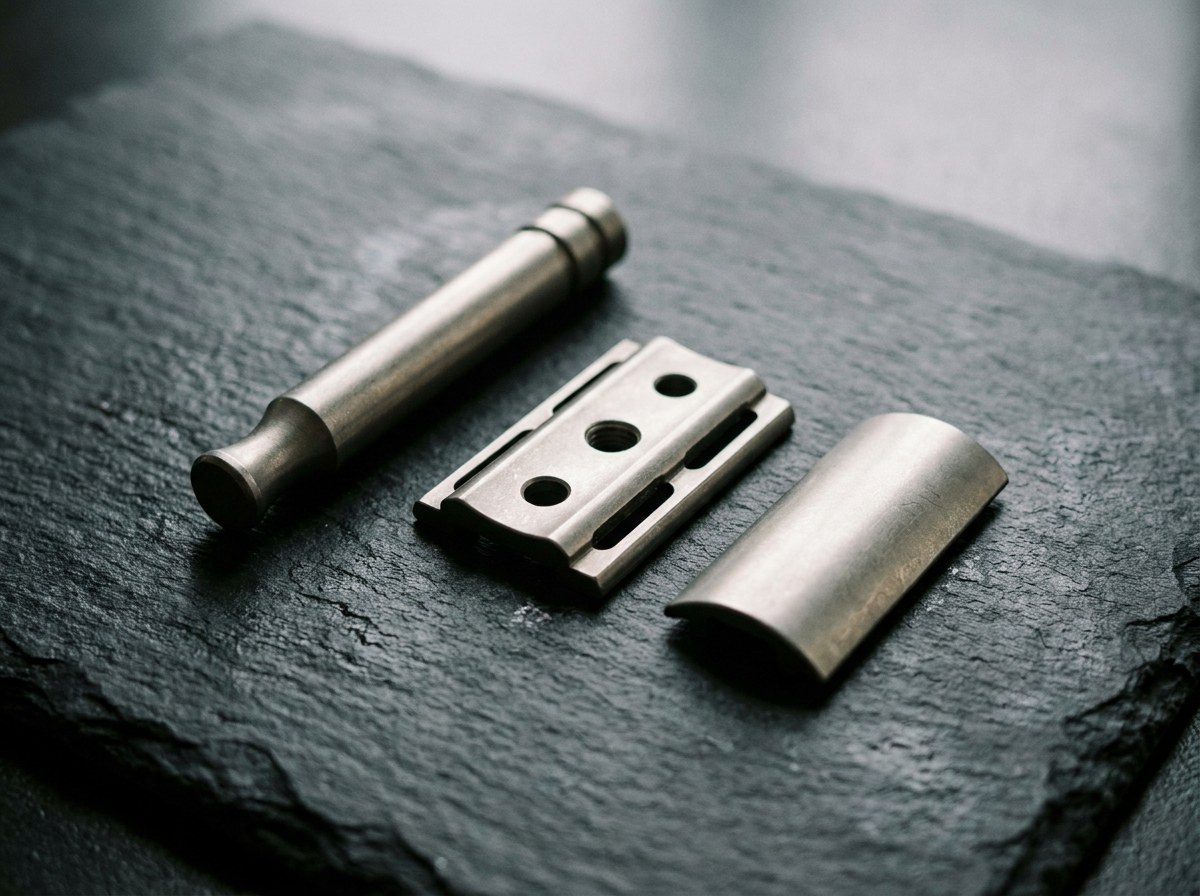
The Rockwell 6S takes a different approach: instead of a fixed head, it ships with three interchangeable baseplates (plates 1-2, 3-4, and 5-6) that change the blade gap and exposure. Lower numbers are milder, higher numbers are more aggressive.
The standard beginner recommendation is to start on plate 3 and stay there until your technique is solid. Plate 3 gives a mild-to-medium shave that is still efficient enough to be satisfying.
The appeal is that you never have to buy a new razor when you want to progress; you just swap a plate. The 6S is made from stainless steel and costs around $100-$120, more than the other options here, but it is genuinely a lifetime purchase.
Sharpologist has featured it repeatedly as a best-value long-term investment for anyone who wants to avoid razor upgrades later.
Check price on Amazonstainless, 6 plates
Henson AL13 Mild
The Henson AL13 is the most mechanically forgiving razor on this list. Henson Shaving, a Canadian aerospace precision manufacturer, designed the AL13 to hold the blade with almost zero flex and to limit blade exposure to an unusually tight tolerance.
The result is a razor where the blade barely protrudes past the safety bar. The community on r/wetshaving describes it as near-impossible to cut yourself with. That is not hyperbole for beginners; it is genuinely the softest-shaving mild razor currently on the market.
The aluminum body keeps weight to 56g, which some shavers prefer and others find too light. It costs around $50-$70 and ships in Mild, Medium, and Heavy variants. For a first razor, Mild is the only version worth considering.
| Razor | Material | Head | Why it suits a beginner |
|---|---|---|---|
| Edwin Jagger DE89 | Chrome-plated zinc | Closed comb | The default first razor. Forgiving, cheap to replace, easy to find. |
| Merkur 34C | Chrome-plated brass | Closed comb | Heavier, so it does more of the work for you. German-made. |
| Rockwell 6S | Stainless steel | 6 swappable plates | Start on plate 1 and climb as your technique improves. |
| Henson AL13 Mild | Machined aluminium | Fixed, 30 degree | Very low blade exposure, which makes over-pressure hard to punish. |
Prices move, and stock does too. Each of these opens the product page on Amazon in a new tab.
Check price on Amazonaluminium, 30 degree angle
A Quick Comparison
| Razor | Aggression | Weight | Price Range | Best For |
|---|---|---|---|---|
| Edwin Jagger DE89 | Mild | 68g | ~$35-$45 | First razor, classic feel |
| Merkur 34C | Mild | 79g | ~$35-$45 | Short handle preference, HD grip |
| Rockwell 6S | Adjustable (start plate 3) | 89g | ~$100-$120 | Long-term investment, adjustable |
| Henson AL13 Mild | Very Mild | 56g | ~$50-$70 | Sensitive skin, maximum forgiveness |
Blade life is personal and it is the number people get wrong. Coarse beards and three passes wear an edge faster than the packet suggests, and a blade used one shave too long is where most weepers come from. Track it for a month before trusting an average.
Sensitive Skin and Mild Razors
If your skin reacts badly to cartridge razors, a mild safety razor will usually be an improvement, not a step backward. The irritation most people blame on shaving actually comes from the multi-blade stacking effect in cartridges, where each successive blade cuts below the skin surface and pulls the hair before cutting.
A single double edge blade at the right angle does one clean pass. Less mechanical trauma means less redness, fewer ingrown hairs, and no razor burn from repeated passes.
For sensitive skin specifically, the Henson AL13 Mild has the strongest track record in the community. The Edwin Jagger DE89 also appears consistently in sensitive skin threads. Both pair well with a glycerin-rich shaving soap and a good pre-shave rinse with hot water.
What Goes With Your First Razor
The razor is only part of the equation. Blades matter enormously, and the correct blade for your skin and beard type is not something anyone can predict for you. This is why every experienced wet shaver tells beginners to buy a blade sampler before committing to a box of 100.
A sampler typically includes 30-50 blades from different manufacturers, covering the full range from smooth-cutting to ultra-sharp. Try 3-4 shaves per blade type and keep notes. Most beginners find they land on something like Astra Superior Platinum or Gillette Silver Blue as their everyday blade.
Beyond blades, a basic kit needs a shaving brush and a soap or cream. A synthetic brush in the $20-$30 range is a solid starting point; you do not need a badger brush to get a good lather.
For technique, the full step-by-step process is covered in the how to use a safety razor guide. Everything from blade loading to lather building to the correct stroke angle is there.
If you want a broader picture of how the whole practice fits together before buying anything, the beginner’s guide to wet shaving is the right starting point.
Razors to Avoid as a Beginner
Stay away from open comb razors and anything with a high aggression rating until you have at least three to four months of consistent shaving technique.
The Muhle R41, often cited as one of the most aggressive razors on the market, will produce spectacular results once you know what you are doing. Before that, it will produce nicks on every pass.
Similarly, skip vintage razor hunting for now. Old Gillettes and Schick injectors can be excellent, but they vary wildly in condition and spec. You will not be able to tell the difference between a well-worn head gap and a correct one until you know what correct feels like on your face.
One blade type to avoid at the start: Feather blades. They are the sharpest blades on the market and are frequently recommended by experienced shavers. For a beginner whose angle control is still developing, that sharpness is a liability.
Frequently Asked Questions
What is the best safety razor for a complete beginner?
The Edwin Jagger DE89 is the most consistently recommended first razor across r/wetshaving, Badger & Blade, and Sharpologist. Its mild head geometry makes blade angle easy to learn, and the price around $35-$45 means you are not over-investing before you know if wet shaving suits you.
What does “mild” mean in a safety razor?
Mild refers to the blade gap and blade exposure, the two measurements that determine how much cutting edge contacts your skin. A mild razor has a small gap and low exposure, meaning small technique errors cause minor irritation rather than cuts. Aggressive razors have larger gaps that cut faster but punish sloppy angles.
Can I use a safety razor on sensitive skin?
Yes, and many people with sensitive skin find it better than cartridge alternatives. The single blade eliminates the multi-blade stacking effect that causes subsurface cutting and irritation. The Henson AL13 Mild has the strongest track record for reactive skin; the Edwin Jagger DE89 is the second most-cited option in sensitive skin threads.
Do I need an adjustable razor as a beginner?
Not necessarily. The Rockwell 6S is worth the higher price if you want one razor that grows with you, but the DE89 or Merkur 34C will serve you well through the learning phase and beyond. Most experienced shavers still reach for mild razors regularly even after years of technique.
How long does it take to learn safety razor technique?
Most shavers report the angle becomes natural within two to four weeks of consistent use, typically 10-15 shaves. The first three shaves feel awkward; by the tenth, most people are not thinking about it. Starting with a mild razor significantly compresses that learning curve.