Rockwell 6S Review: Adjustable Stainless
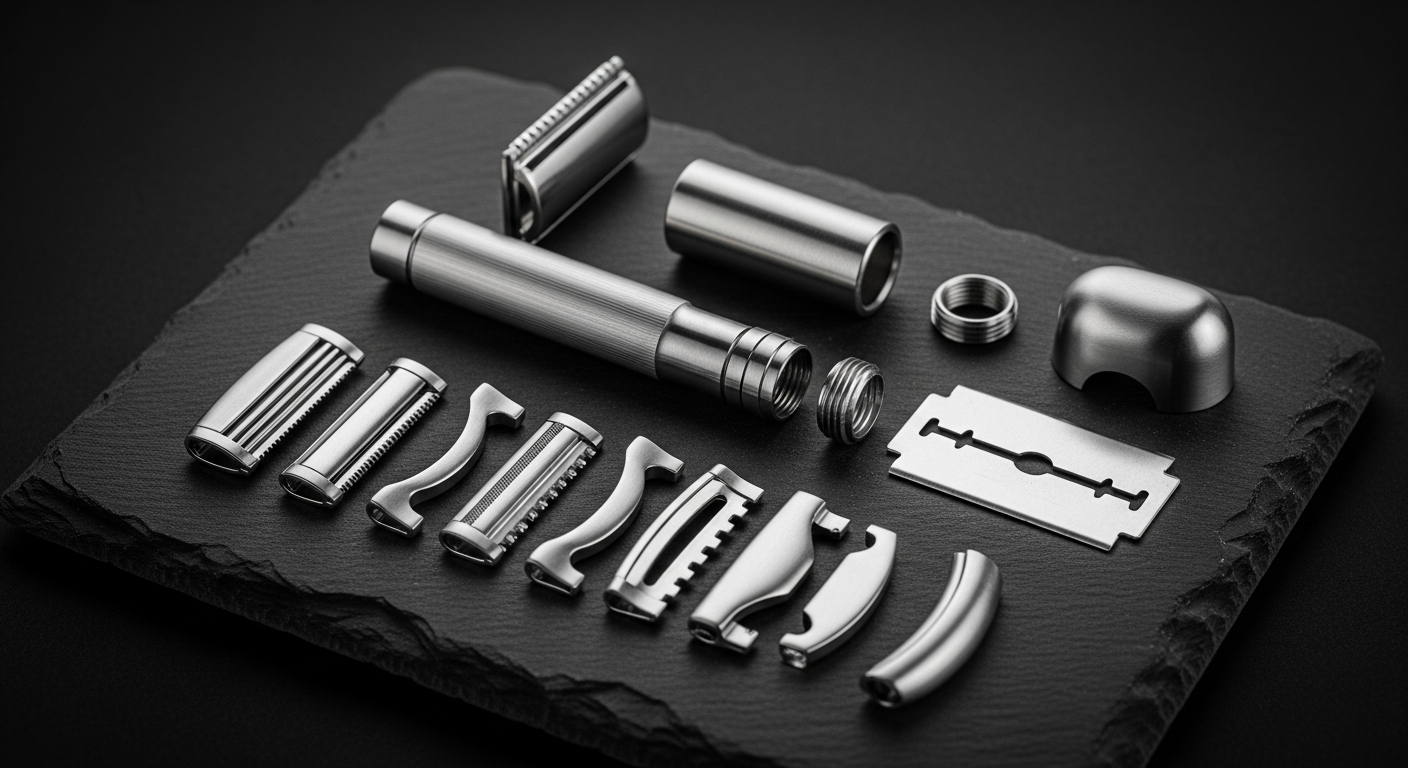
The Rockwell 6S is the razor r/wetshaving and Badger & Blade keep recommending when someone asks for the last razor they should ever need to buy. Six aggressiveness settings across two swappable stainless baseplates, a body machined from 316L surgical-grade stainless steel, and a street price around $100 put it in a rare category: genuinely beginner-friendly on the mild end, genuinely capable on the aggressive end. That range is why it consistently tops community lists of the best safety razor for shavers who refuse to buy multiple razors. You start on the mild settings, build your technique, and the razor scales with you as your skill develops and your preferences sharpen.
One purchase, one razor, six different shaves depending on which plate you load. That is the whole pitch, and for most shavers it delivers.
How the Plate System Actually Works
The Rockwell 6S ships with two baseplates. Each baseplate has two usable sides, labeled R1 through R6. R1 is the mildest, R6 is the most aggressive. You pick your plate, snap it into the two-piece head, tighten the handle, and shave.
The geometry changes how much blade gap and blade exposure you get. A wider gap lets more blade contact the skin and removes more stubble per pass, but it also demands better technique. A tighter gap is forgiving when your angle drifts.
| Setting | Character | Best For |
|---|---|---|
| R1 / R2 | Mild | Sensitive skin, first weeks of wet shaving, post-surgery recovery |
| R3 / R4 | Moderate | Daily shavers, normal to slightly coarse beards, the community sweet spot |
| R5 / R6 | Aggressive | Coarse beards, 2-3 day growth, experienced shavers who want efficiency over forgiveness |
Most shavers on Badger & Blade land permanently on R3 or R4. R5 and R6 see use among people with thick, dense beards or those who prefer a single-pass shave over a three-pass. R1 is genuinely useful for sensitive-skin days or when your technique breaks down and you need a reset.
The swap itself takes about ten seconds once you have done it a few times. Unscrew the handle, swap the baseplate, retighten. Not difficult, but not instant either.
Build Quality: What You Actually Get for the Price
The head and both baseplates are 316L stainless steel, the same alloy used in surgical instruments. It does not corrode. It does not pit. The community consensus documented by Sharpologist is that a well-maintained Rockwell 6S will outlive a plastic-handled razor by decades, and since there are no moving parts to fail, the math checks out.
The finish is a smooth satin, not polished chrome. It resists water spots better than a mirror finish and feels more substantial in the hand. Weight sits in the medium-heavy range, which helps maintain blade angle without forcing you to press.
Dishwasher-safe is a genuine claim here, not marketing. The stainless tolerates the heat and detergent cycles that would corrode a zinc-alloy razor inside a year.
Shave Quality: What the Community Reports
On R3, the Rockwell 6S consistently earns descriptions like “smooth,” “efficient,” and “forgiving enough that technique matters less than it does with a more aggressive razor.” Blade choice matters more than with a forgiving fixed-blade razor, and the community generally pairs it with mid-range blades like Astra Platinum or Gillette Silver Blue rather than the sharpest options on the market.
On R5 or R6, the character shifts noticeably. Feedback from Badger & Blade threads describes it as “efficient and decisive” on those settings, with the caveat that technique has to be on point. Angle discipline and zero pressure are non-negotiable at the aggressive end.
For context on how blade geometry affects your shave quality, the guide on mild vs aggressive razors covers the trade-offs in more depth.
Who Should Buy the Rockwell 6S
The person who gets the most value here is someone starting wet shaving who wants to buy once and not revisit the decision. You start on R2 or R3, build technique, and the razor scales with you. No separate “beginner razor” purchase, no upgrade cycle.
The second buyer is the tinkerer who wants to understand how blade exposure changes the shave. The six-setting range makes the Rockwell 6S a better teaching tool than any fixed-geometry razor. You can feel the difference between R3 and R5 in a single session.
If you already own several razors and are filling a gap in your collection, the 6S fills the “all-around workhorse” slot that many collectors keep for daily use while rotating more exotic pieces on weekends.
Who Should Skip It
If you want the simplest possible entry into safety razors without spending $100 upfront, this is not your razor. The plate-swapping feature you are paying for becomes irrelevant if you find a setting that works and never touch it again.
Shavers with very fine, sparse beards often find that even R1 is more razor than they need, and a lighter fixed-blade razor at a lower price point would serve them better without the complexity.
If the idea of losing a baseplate mid-travel concerns you, note that the system requires you to keep track of two baseplates. It is a minor logistical consideration, not a dealbreaker, but worth naming.
Honest Cons
- Price: at around $100, it costs significantly more than a Merkur 34C or the zinc-alloy Rockwell 6C
- Weight: heavier than some shavers prefer, particularly those coming from cartridge systems
- Plate swapping: takes adjustment time and requires keeping track of the spare baseplate
- No travel case included at the base price
Rockwell 6S vs Rockwell 6C
The Rockwell 6C uses the same six-plate system but the head and baseplates are zinc alloy with a chrome coating rather than solid stainless. It typically sells for around $40-$50 less. The shave geometry is identical, the plate system works the same way, and for most shavers the actual shave quality difference is minimal.
The gap is durability and corrosion resistance. Zinc alloy with a chrome finish will eventually show wear, particularly at the plate edges where the chrome is thin. For a shaver who will use one razor for a decade, the stainless version justifies the premium. For someone testing whether the plate concept suits them before committing, the 6C is a rational starting point.
Rockwell 6S vs Merkur 34C
The Merkur 34C is the most recommended fixed-blade safety razor for beginners, and for good reason. It is mild, forgiving, well-built, and costs under $50. There is no plate system to manage, no decisions to make. Load a blade, shave, rinse.
The 34C wins on simplicity and price. The 6S wins on range and material quality. A shaver who knows they want to stay in wet shaving long-term and values flexibility will find the 6S worth the additional cost. A shaver who wants to spend less and just wants a good shave every morning is well-served by the 34C. Read the full Merkur 34C breakdown if you are deciding between them.
The two are not really competing for the same buyer. If you need help narrowing down which type suits your situation, the best safety razor for beginners guide walks through the decision criteria without assuming you already know which direction to go.
If the Rockwell 6S fits your shaving profile, you can check the current street price and available finishes on the product page before you decide.
Frequently Asked Questions
What plate should a beginner start on with the Rockwell 6S?
R2 or R3 is where most community members recommend starting. R3 is the consensus daily-driver setting and gives you enough blade feedback to learn technique without being punishing. Start there for the first few weeks before experimenting upward.
Is the Rockwell 6S worth it over the 6C?
If you plan to use one razor for years, yes. The 316L stainless steel construction will not corrode or chip. If you are testing whether the plate system suits you, the Rockwell 6C at a lower price gives you the same geometry without the material premium.
What blades work best with the Rockwell 6S?
The community most commonly pairs it with mid-sharp blades like Astra Platinum, Gillette Silver Blue, or Feather on the milder settings. On R5 or R6, a sharper blade is less critical because the geometry already provides efficiency. Blade preference is personal; a sample pack is the standard recommendation for finding your match.
How do you clean the Rockwell 6S?
Rinse under hot water after each shave, tap out excess water, and leave it disassembled to air dry. The full razor is dishwasher-safe on the top rack. A soft toothbrush clears soap buildup from the baseplate channels. No special products needed.
Does the Rockwell 6S work with standard DE blades?
Yes. It accepts any standard double-edge blade. The two-piece head design makes loading clean and uncomplicated: unscrew the handle, drop in the blade, reassemble. No blade alignment tricks required.